
image description

Grade 8

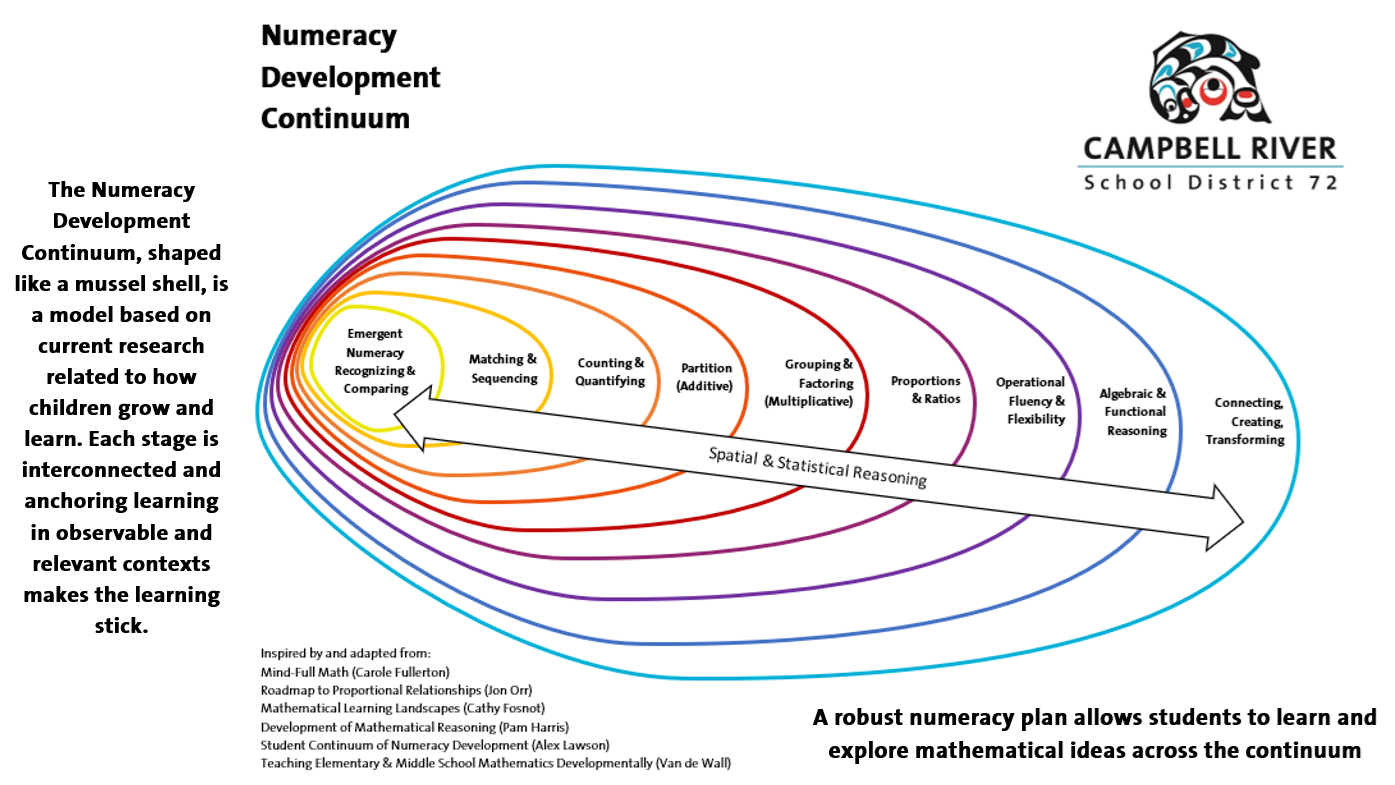
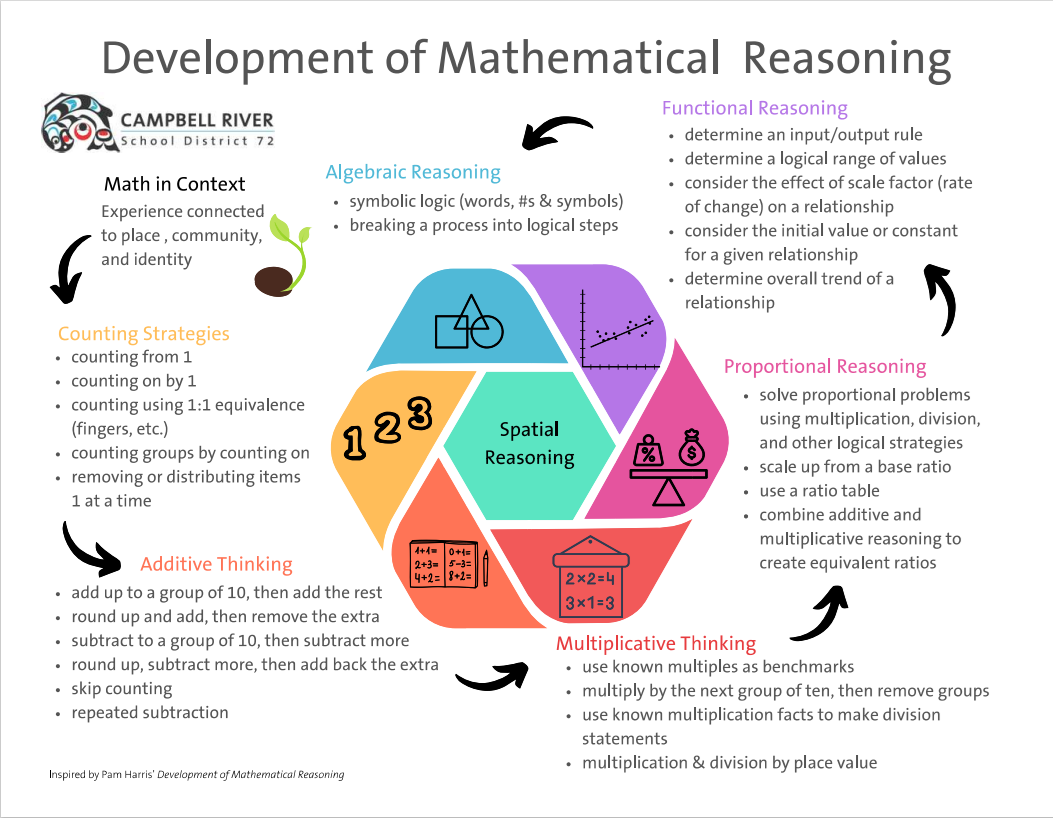
Students in Grade 8 expand their computational fluency and proportional reasoning to include percentages and fractions with unlike denominators. The emphasis is on using ratios & proportions and common geometric formulas for area and volume, as well as solving equations with whole number solutions. Student practice using symbolic logic (algebra) to communicate multi-step problem solving. Visual models include a number line and a cartesian plane with values less than zero, tree and table models of multiplication/factors and visual patterns represented as input/output tables.
1769104360578.39b69324156.png1769624302565.65669724191.png

In the table below, you will find instructional resources organized by theme as well as according to discrete skills for Grade 8 Math 

Note: 

Operational Fluency refers to ease of recognition of which operation is required for a given problem and Computational Fluency (the proficient use of various models and strategies to perform the desired operation) 

Brochure with common models and strategies used to develop operational fluency in Grades 6 & 7 (Prior Learning)

Prior Learning (Grade 6 & 7)Number Grids 
Whole Number Pickle Game

Fractions and Integers on a number line
Greater Than, Less Than Fractions Game
Represent Decimals and Fractions on a Grid

Decimal Pickle Game
Rules and Template
Area/Array Model 
Multiplying using Rectangles 
Array Capture Game

Shikaku Puzzles
Multiplication Table 
Bar Model and Grid Model (for fractions)
Compare benchmark fractions (ie. using fraction bars)
Common Models for Grade 8

Virtual Math Manipulatives

Number Line 
Cartesian Plane
Visual Patterns
Math Glossary 
Word Wall (Vocabulary)

Math Glossary (K-8)
Array/Area model of multiplication Lesson

True Scale Multiplication Grids
Communicating and Representing 
Math Number Talks Provocations Examples

Math Questions to Promote Thinking

Good Questions for Grade 6,7,8 (Carole Fullerton)

Division Contexts (Write problems for a given context)

Benchmarks / Estimation 


Perfect Squares and Cubes

Benchmarks for time, distance, temperature
10 steps to estimate reasonably
Estimation Mysteries (by Steve Wyborney)
Grade Range Chart
Finding the Mode (Central Tendency) - the most common value in a data set

Reasoning and Analyzing

Mathematical Reasoning Twist Model Poster

3-Act Tasks and Thinking Tasks

3-Act Examples

Open Middle Problems (Kaplinksy)

Open Middle - Challenging math problems worth solving
Visual Patterns Tasks (patterns to tables to algebraic forms)


Operational Fluency
 Multiplication / Division

True Scale Multiplication Grids
Prime Numbers and Factorization

Prime Factor Puzzles and Games

Square and Cube Roots
Pythagorean Tables (Multiplication)

Tarsia Puzzle Multiplication Facts
Scale Factor (x2, x10, x1000, etc.)

Unit Rates (km/h, $/L, etc.)

Order of Operations with fractionsConcrete representations of operations with fractions:
Dividing with a Rectangle 

bar/pie/number line for add/subtract
Making Sense of Fraction Addition 

Subtracting Negatives without Tricks 

area/window for multiply/divide

Abstract (Symbolic) representations of operations with fractions (may include standard algorithms and mnemonic devices)Central tendency: Calculating Mean and Median

Application: Calculate Probability of 2 Independent Events (Theoretical)


Fractions / Ratios / Proportions / PercentagesSample Fraction Splats Lesson
Unit Chats
Tiled Area Tasks
Solving Proportions 
Ratio Tables
Sample Ratio Lesson Plan 
Financial Literacy (best buys)

Calculate taxes and tips 
Understand and Solve (Equations) Solve Mojis, Math Mojis 

Math Mobiles (model solving equations with whole numbers)
  • expressions- writing and evaluating using substitution
  • Pythagorean Theorem

Algebra and Visual Patterns (write equations to represent patterns)

Measurement & Geometric ReasoningDimensions of common 2D shapes
  • Pythagorean Theorem (right triangles)

Deriving 6 Area Formulas from the Area of a Rectangle 


Connecting 2-D shapes and 3-D objects


Connecting and Reflecting

Culturally Sustaining Pedagogy

Interweaving Math Poster
Connecting to Place
Exploring West Coast Ecosystems
 Land and Resource Stewardship 
(Greenways, Forest School, etc.)

Land-based, experiential learning
  1. Beaches (Various)
  2. Islands (Quadra, Cortes, Reade)
  3. Forests (Beaver Lodge Lands, etc.
  4. Wetlands (Various)
  5. Rivers (Fish Hatchery, Quinsam River)
  6. School Gardens
Seasonal Round and 13 Moons Calendar Lessons (Resources Under Development)
Connecting to Language
Using counting words, colour words, and other words to describe shape, quantity, and location (in Kʷak̓ʷala and Lik̓ʷala, English, French, and/or ayʔaǰuθɛm)

Contact the Indigenous Education Department for more information. IndigenousEd@sd72.bc.ca

French Resources (Page Under Development)

Connecting to Culture and Community
Learning from members of various Indigenous communities: Liǧʷiɫdax̌ʷ (We Wai Kai, Wei Wai Kum), Xwémalhkwu (Homalco), Klahoose, Tlowitsis, Comox, Métis, etc.)

Contact the Indigenous Education Department for more information. IndigenousEd@sd72.bc.ca

FNESC Math First Peoples Guide

FNESC Math 8 & 9 Resource
Planning for Proficiency

BIG IDEAS K-9
Unit Planning Template

Connecting Curricular Competencies to Depth of Knowledge (Summary Table)
Fractions Iceberg Concept Map (p.1)
Multiplication Iceberg Concept Map (p.2)
Algebraic Reasoning Concept Map (p.3)
Skills Trajectories (Multi-Grade Proficiency Tables)

Fraction, Decimal, Percent Trajectory
Mathematical Modelling Trajectory
Measurement Trajectory

Instructional and Assessment Routines

Common Formative Numeracy Assessment (CFNA) 
Section 8 of the District Numeracy Framework

SNAP Number Sense Instructional Routine

SNAP Grades 2-9

5 Indicators of Decimal Understanding (NCTM article)

Grade 6-9 Numeracy Sampler Pack

Sampler Pack Table of Contents 

Essential Skills Numeracy Self-Assessment (From Human Resources and Skills Development Canada)

Games for Gaps
Games for Fluency Building in Math 

BEAM Math Games for Grades 5-7

High-Yield Routines for Middle School Math

Curated list with links to recommended resources


image description
Back to top