Grade 9
Math 9 ties together number sense, computational fluency, spatial reasoning, and problem-solving skills in preparation for applied math and science courses, precalculus, physics, chemistry, etc. Success in high school mathematics and beyond requires proficient application of the skills and knowledge introduced in earlier years. As such, a portion of the grade 9 year includes reinforcing, connecting, and expanding depth of understanding of various key concepts from middle school.
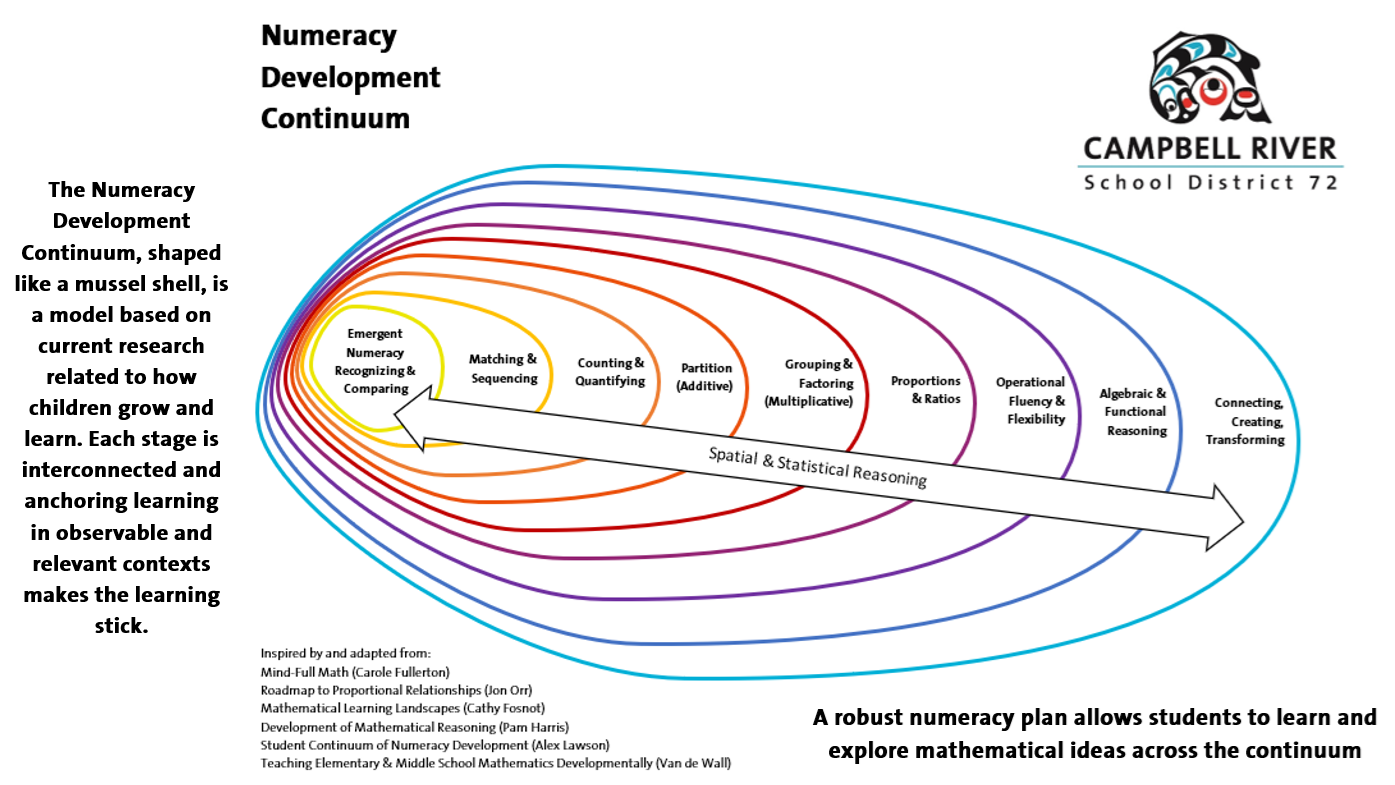
Key Prior Skills and Knowledge
| Number Sense (Rational Numbers, Integers, Prime and Composite Numbers, Fraction and Decimal Notation) Decimal Pickle Game Rules and Template Prime Factor Puzzles and Games Model Fractions and Decimals Compare Fractions Fractions and integers on a grid, number line Fraction Bingo | Operational Fluency (Multiplicative Reasoning and Priority of Operations) Pythagorean Tables (Multiplication) Yohaku Junior Puzzles (Additive and Multiplicative) Shikaku Puzzles (Array Multiplication) Kakooma Multiplication Puzzle Tarsia Puzzle Multiplication Facts | Proportionality & Ratios Ratio Tables (Model) Example by Pam Harris Represent Decimals and Fractions on a Grid | Algebraic Reasoning (Writing and Solving Simple Equations) Math Mobiles (model solving equations with whole numbers) | Data Visualization and Analysis (Bar Graphs, Circle Graphs, Line Graphs) True Scale Multiplication Grid High Yield Routines for Middle School |
Developmental Approaches to Numeracy Instruction
| Planning for Proficiency BIG IDEAS K-9 | Depth of Knowledge (DOK) Unit Planning Template Connecting Curricular Competencies to Depth of Knowledge (Summary Table) | Concreteness Fading Concept Maps Fractions Iceberg Concept Map (p.1) Multiplication Iceberg Concept Map (p.2) Algebraic Reasoning Concept Map (p.3) | Skills Trajectories (Multi-Grade Proficiency Tables) Fraction, Decimal, Percent Trajectory Mathematical Modelling Trajectory Measurement Trajectory |
Instructional and Assessment Routines
| Common Formative Numeracy Assessment (CFNA) Section 8 of the District Numeracy Framework SNAP Number Sense Instructional Routine SNAP Grades 2-9 5 Indicators of Decimal Understanding (NCTM article) | Grade 6-9 Numeracy Sampler Pack Sampler Pack Table of Contents Essential Skills Numeracy Self-Assessment (From Human Resources and Skills Development Canada) |
| Assessing Math 9 Curricular Competencies and Content Rich Task Self Assessment Template Sample Math 9 Competency Report Template | High Yield Routines for High School (9+) Curated list with links to key resources |
Math 9 Curricular Competencies and Content
MATH 9 - Curricular Competencies Assessed using the Proficiency Scale (Emerging/Developing/Proficient/Extending) | Topic 1: Operations with rational numbers (addition, subtraction, multiplication, division, and order of operations) Practice Test | Topic 2: Exponents and exponent laws with whole-number exponents | Topic 3: Operations with polynomials, of degree less than or equal to 2 | Topic 5: Two-variable linear relations, using graphing, interpolation, and extrapolation Practice Test | Topic 6: Spatial proportional reasoning | Topic 7: Statistics in society | Topic 8: Financial literacy — simple budgets and transactions | |
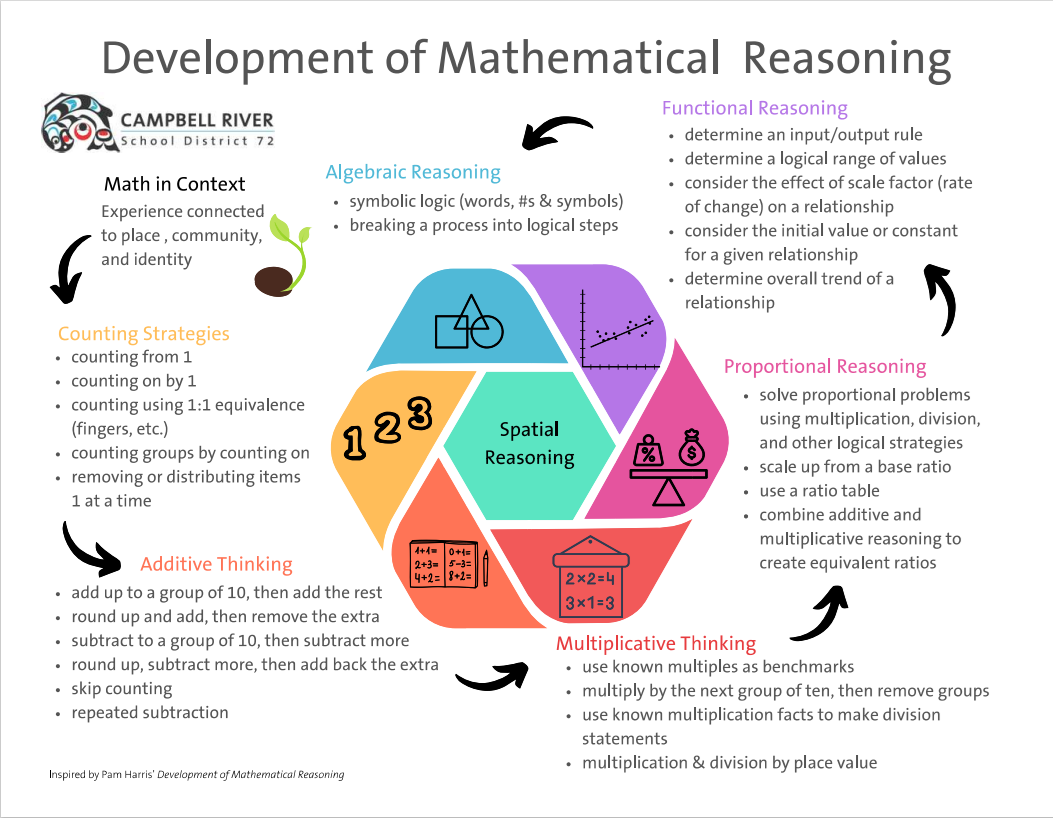
| Reasoning & Analyzing Development of Mathematical Reasoning (Poster) | ||||||||
| Use logic and patterns to solve puzzles and play games Game Selection Criteria | tarsia | tarsia | exponent puzzles | Solvemojis | Shikaku (Area Puzzles) | |||
| Use reasoning and logic to explore, analyze, and apply mathematical ideas | Open Middle Tasks | Pythagorean theorem | | | | Burger 3-Act Task | ||
| Estimate reasonably Esti-Mystery Grade Range | | Pythagorean Problems | Rate Problems | |||||
| Demonstrate and apply mental math strategies | Area calculations, connecting area and radius of a circle | Use Opposite Operations to isolate a variable | | |||||
| Use tools or technology to explore and create patterns and relationships, and test conjectures Virtual Math Manipulatives | Scientific Calculator | Exponent Keys on Calculator | Algebra Tiles | Graspable Math app | explore rate of change, increasing and decreasing functions | |||
| Model mathematics in contextualized experiences | Represent elevation, budget, fishing depths (integers) | pH scale, Richter scale, scientific notation | "Patterns to Algebra" Progression | Water, Water Thinking Task | Land use data, fish returns data, sports data | Draw a line graph to show change over time | ||
| Understanding & Solving | ||||||||
| Apply multiple strategies to solve problems in both abstract and contextualized situations | Standard algorithms, visual models, estimation strategies | Use formulas for Area and Volume | Use grouping and factoring to simplify expressions | Apply properties of algebraic equations | Use ratio tables | |||
| Develop, demonstrate, and apply mathematical understanding through play, inquiry, and problem solving Teaching Through Problems Worth Solving | | | | | | | | |
| Visualize to explore mathematical concepts | Scale models and scientific diagrams | Tiling problems How to Measure like a Canadian | Data visualizations from various sources | |||||
| Engage in problem-solving experiences that are connected to place, story, cultural practices, and perspectives relevant to local First Peoples communities, the local community, and other cultures FNESC Math 8 & 9 Resource Cumberland Forest Study Guide | Graphing Stories | Go With the Flow Stormwater Guide | Land use, water, forestry data, fish returns data, sports data, demographic data, election data Basketball Analytics Unit | Film: Rendering Wealth | ||||
| Communicating & Representing | ||||||||
| Use mathematical vocabulary and language to contribute to mathematical discussions Math Glossary (K-8) Math 9 Glossary (French) | convert, improper, elevation, minimum, maximum, evaluate, factors, multiples, even, odd, prime, rational, integers | exponent, base, power, scientific notation | evaluate, simplify, distribution, regrouping (associative property) | solve, isolate, substitute, verify | linear, increasing, decreasing, constant, rate of change | proportional, scale factor | Graphing Stories | |
| Explain and justify mathematical ideas and decisions | Which One Doesn't Belong?Tasks | Would you rather... | financial literacy — share plans for simple budgets and transactions | |||||
| Communicate mathematical thinking in many ways | Circle graphs (percentages, fractions) | Using a graph | Using Geometric Formulas | Spreadsheet or Table | ||||
| Represent mathematical ideas in concrete, pictorial, and symbolic forms | Venn Diagrams, Sets, Process diagrams, sketch geometry contexts | Window method for multiplication and division with polynomials | Algebra Tiles | |||||
| Connecting & Reflecting | ||||||||
| Reflect on mathematical thinking (I can statements, goal setting, learning from mistakes) | Self-Assessment (Myself in Math) | |||||||
| Connect mathematical concepts to each other and to other areas and personal interests | Taxation, Tips (Percentages), Temperature (Integers) | Science (Magnification, Distances in Space), pH | Economics | Personal Fitness Goals, Sleep Habits, Rate of Pay | Architecture, Engineering, Art, Design, Travel (currency exchange) | History and Current Events, Probability of rain/snow | Future (Career Paths) | |
| Use mathematical arguments to support personal choices | financial literacy — simple budgets and transactions | Future (Career Paths) | ||||||
| Incorporate First Peoples worldviews and perspectives to make connections to mathematical concepts | Priorities, Interconnectedness of parts and wholes | Limits, Infinity | Reciprocity and distributing according to needs | Balance, Equality | Learning (growth) takes time | Pictures can help us imagine and design things. Accurate drawings reduce waste and save time | Some stories are sacred. We can learn from stories, from history, and from each other | Growth takes time. Investing in yourself is one way to contribute to your community. |
Interdisciplinary Numeracy
| Culturally Sustaining Pedagogy Interweaving Math Poster | Connecting to Place Exploring West Coast Ecosystems Land and Resource Stewardship (Greenways, Forest School, etc.) Land-based, experiential learning
| Connecting to Language Using counting words, colour words, and other words to describe shape, quantity, and location (in Kʷak̓ʷala and Lik̓ʷala, English, French, and/or ayʔaǰuθɛm) Contact the Indigenous Education Department for more information. IndigenousEd@sd72.bc.ca French Resources (Page Under Development) | Connecting to Culture and Community Learning from members of various Indigenous communities: Liǧʷiɫdax̌ʷ (We Wai Kai, Wei Wai Kum), Xwémalhkwu (Homalco), Klahoose, Tlowitsis, Comox, Métis, etc.) Contact the Indigenous Education Department for more information. IndigenousEd@sd72.bc.ca FNESC Math First Peoples Guide |