




1. Prioritize Learning Standards
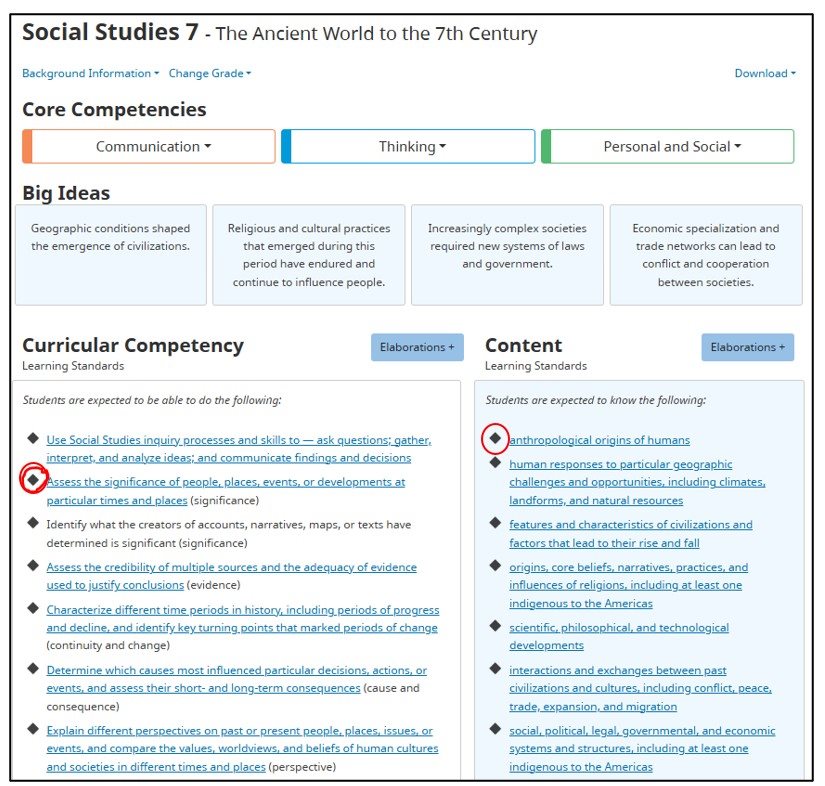 |  A Learning Standard |
What is a learning standard?
A learning standard unifies content (what a student knows) and competency (what they do with that knowledge) into one single, actionable sentence or statement, often described as a "Know-Do" framework.
Examples of learning standards:
- Science: "Students will analyze the phases of the lunar cycle (competency) to explain how the relative positions of the Earth, Moon, and sun affect tides (content)."
- Language Arts: "Students will evaluate a persuasive text (competency) by identifying the author's use of bias and evidence (content)."
- Math: "Students will model real-world scenarios (competency) using linear equations and graphs (content)."
Why do we need to prioritize standards?
According to Garth Larson, Ken O'Connor, and Becky Peppler, the number of learning standards in BC's curriculum requires school teams to develop a process to determine which standards are an absolute priority for all students to become proficient in (STAGR Center, FIRST Educational Resources, 2023).
Standards can be evaluated by the following criteria:
R - Readiness: Does the standard prepare students for future grade, competency, and content levels? Is it a prerequisite for future learning?
E - Endurance: Is this standard valuable over time, beyond a single test date? Is it taught and assessed many times throughout the school year?
A - Assessments: Does this standard adequately prepare students for local and provincial assessments?
L - Leverage: Is this standard useful in multiple disciplines? Does it have cross-curricular implications? Is it taught in one subject, but used in another?
How many do we need to teach?
Ken O'Connor recommends teachers explicitly instruct and assess 4-8 standards per subject, per year.
References
O’Connor, K. (2005). How to grade for learning: Linking grades to standards (2nd ed.). Corwin Press.

 Google Translate